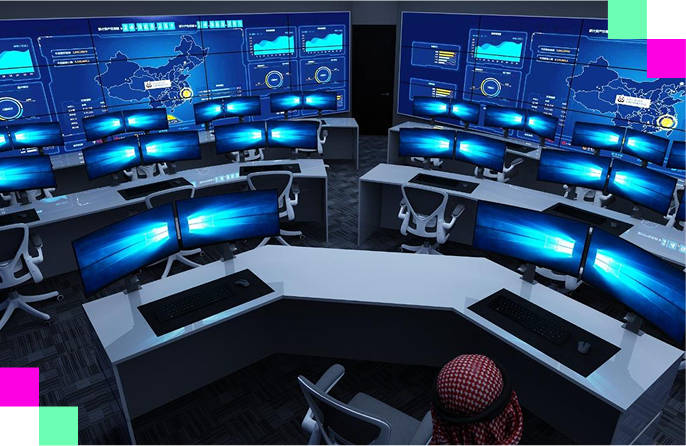
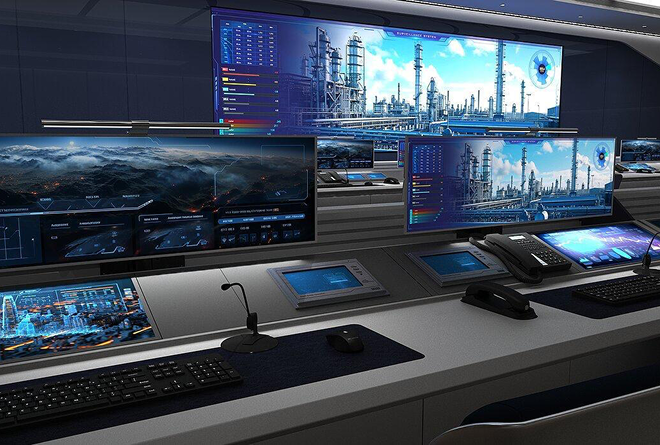
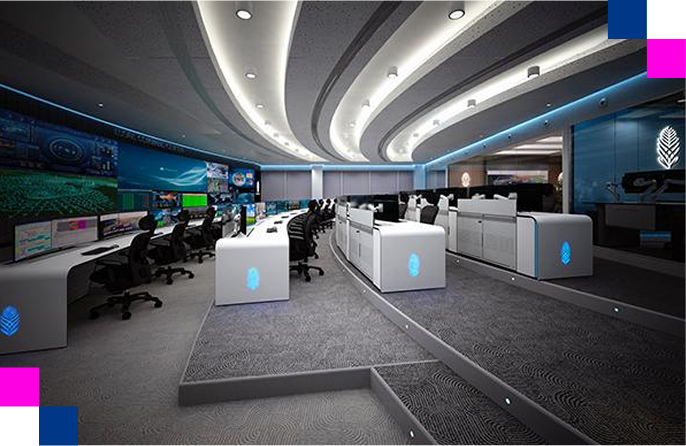
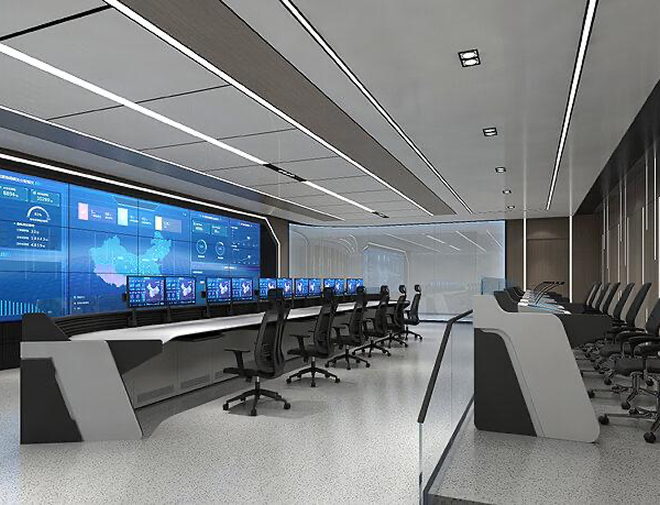
RTC designs and builds command centers that support real-time monitoring, operational coordination, and informed decision-making. These environments must operate 24/7 and maintain full visibility across systems and processes. Our designs prioritize workflow efficiency, visual clarity, reliability, and operator comfort.
Core Capabilities Design & Layout Development
Our engineering team evaluates sightlines, viewing distances, control interfaces, and operator placement to create layouts that support seamless operations. The goal is to enhance efficiency while reducing fatigue during extended shifts.
Operator positioning
Circulation and room flow
Supervisor and visitor zones
Audiovisual
& Visualization Systems
High-resolution video walls
Signal distribution systems
Operator monitor arrays
Integrated presentation tools
Technical
Infrastructure
RTC ensures all cabling, power routing, and rack integration follow best practices for maintainability and stability. Cable management standards reduce clutter and simplify troubleshooting, while redundancy is built into essential pathways.
Command & Control Centers
Data Center Infrastructure
Manpower & Managed Services
Technology Alignment Across the Group
Environmental
Optimization
Lighting, acoustics, ergonomics, and thermal comfort significantly impact operational performance. RTC designs environments that maintain clarity, reduce distractions, and support continuous operation.
Types
of Command Centers
Utilities & infrastructure operations
Transportation monitoring
Transportation monitoring
Control & dispatch centers
Executive decision rooms
Delivery
Approach
Our phased delivery model ensures smooth transitions from planning to commissioning:
1. Requirements capture
2. Conceptual design
3. Engineering documentation
4. Infrastructure build
5. System integration
6. Testing & commissioning
7. Training & handover
System
Integration Architecture
RTC integrates power, signal, AV, and environmental subsystems into a coherent operational architecture. Cabling pathways are separated to minimize interference; racks are arranged for airflow and grounding consistency; redundant signal paths protect against failure. This architecture ensures consistent performance, reduces operational risk, and supports future upgrades without interruption.
Types
of Command Centers
Signal path design minimizing latency across all endpoints
Separation of low-voltage and power lines
Redundant feeds for critical visualization equipment
Cable dressing standards and labeling for long-term serviceability
Equipment grounding to prevent noise and instability
Cooling considerations around high-density AV components